Window of Archipelago

La Galigo - Similar to the Koran but older than the Koran

Ujungpandang ( Dreamland Library ) - The Bugis in South Sulawesi, adheres to a belief in the Gods of Seuwae (the Only God). "The Bug...

Showing posts with label Culture. Show all posts

Cave paintings in Sulawesi - 38000 BC

Jakarta (DreamLandLibrary) - The days are getting stronger, that the beginning of civilization came from the archipelago.

Original Title: Cave Painting in Sulawesi, the Oldest in the World

The hand-painted stencil found in the Maros cave, Sulawesi, is estimated to be 40,000 years old. "Nature" magazine reports on research by a team of experts from Australia and Indonesia.

During this time, hand and animal stencils on the walls of the cave that are considered the oldest are in Europe, namely in the cave of El Castillo in northern Spain, which is estimated to be 37,300 years old.

But according to the latest research, hand stencil paintings on the walls of the Maros cave in South Sulawesi are still older. The ancient inhabitants allegedly painted the hand drawing about 40,000 years ago. Thus the results of the research were conducted by a team of experts from Australia and Indonesia.

The expert team led by Anthony Dosseto from the University of Wollongong, Australia, examined seven caves in Sulawesi with 12 paintings, namely hand stencils drawn in red and drawings of babirusa animals.

These paintings have actually been discovered more than 50 years ago. But detailed research has never been done to determine its age. Previous experts thought that such paintings made in tropical climates would not last more than 10,000 years.

A new view of human evolution
The research team from Australia and Indonesia then conducted a repeat study. The latest research results in the Maros cave of Sulawesi can change the view of the history of the spread and human civilization.

The hand-painted stencil is estimated to be at least 40,000 years old, while the babirusa painting is probably more than 35,000 years old. The expert team said, this is one of the oldest animal paintings, "if not the oldest" in the world ever found.

"With this it can be proven, that humans around 40,000 years ago spread in various directions," said Anthony Dosseto. "Europe can no longer claim that they were the first to be able to develop abstract paintings."

The determination of the age of the paintings in the cave was carried out by the uranium measurement method. The calculation is based on the decay of radioactive elements. With this method, a minimum age for a painting can be determined. That means the paintings might be older.

Important discovery
Research on the age of ancient paintings in caves is considered important, because the paintings are an indicator that the painter "has the ability to think abstractly," said Thomas Sutikna, a member of the research team from the University of Wollongong.

The results of this latest research again emphasize the important role of the Asian continent in the process of human evolution. Earlier in 2003, a spectacular discovery of homo floresiensis (Flores Man) was also carried out, also known as Hobbit because of his small body.

Source: http://www.dw.de/lukis-gua-di-sulawesi-tertua-di-dunia/a-17986287

Image Source: http://www.dw.de/image/0,,17984037_303,00.jpg
Ancient Painting from the Land of Java - 498000 BC

Original Title: Terkuak, Gambar Kuno Tertua di Dunia Berasal dari Tanah Jawa
Jakarta (DreamLandLibrary) - The oldest nicks in the world found on the shell apparently come from the land of Java, precisely from the Trinil site, Ngawi, East Java. Research published in Nature on Monday (1/12/2014) revealed it.

Josephine CA Jordens, a researcher at the Faculty of Archeology at the University of Leiden, the Netherlands, and her colleagues is the party that confirms that the incision is the oldest, dating from the period of 500,000 years ago.

Jordens is working on a research project on the use of marine resources by the ancient human species Homo erectus at the Trinil site, East Java. He then analyzed the freshwater shells of the Pseudodon vondubangchianus trinilensis species.

When analyzing, he found perforations or small holes a few millimeters wide on the surface of the shells. According to him, it was an indication that there were people at that time who tried to open the shell with sharp tools like shark teeth.

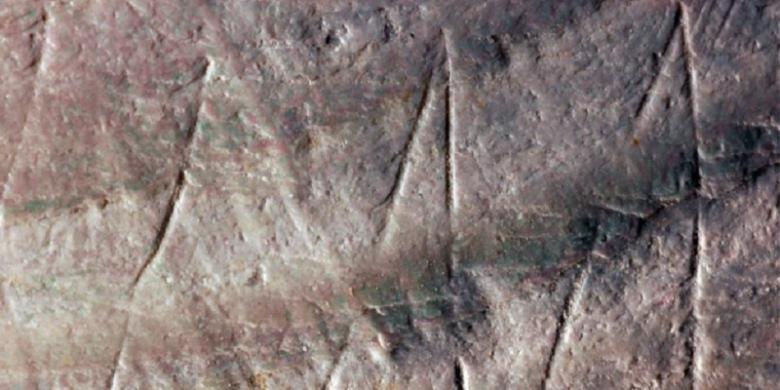
Jordens' colleagues then took a picture of the shell and examined it in more detail. Through careful observation, it is known that the surface of the shell has zig-zag-shaped nicks.

Observation under a microscope then reveals that the zigzag pattern was made intentionally. The zigzag lines, each of which are 1 cm long, are continuous, unbroken, showing that the maker is paying attention to details.

Jordens and colleagues dated the sediments contained in shells with argon and luminescence. The results of the calendar reveal that the zigzag pattern originated from 500,000 years ago, not made by Homo sapiens, but Homo erectus.

"This discovery is very spectacular and has the potential to change our perspective about Homoawal (ancient humans)," said Nick Barton, an archeologist from Oxford University who was not involved in the study.

Is the incision an art form? Jordens said, "If you don't know the purpose of someone who made it, then it's impossible to call it art."

"However, on the other hand, this is an ancient picture. This is a way to express yourself. What is the purpose of the people who made it, we do not know," Jordens said as quoted by Nature, Wednesday (12/03/2014).

Clive Finlayson, animal expert from the Museum of Gibraltar who was also involved in the study, said the most important of these findings was that early humans already had the ability to think abstractly, just like modern humans.

The shells analyzed were found by paleontologist Eugene Dubois at the Trinil site in 1896. Dubois also discovered the skeleton of Homo erectus. The skeleton and shell were then sent to the Leiden Museum in 1930.

Source: http://sains.kompas.com/read/2014/12/04/19405611/Terkuak.Gambar.Kuno.Tertua.di.Dunia.Berasal.dari.Tanah.Jawa

Image Source:

http://assets.kompas.com/data/photo/2014/12/04/1932040gambar-zig-zag780x390.jpg

Gamolan Lampung - 200 Years BC

Jakarta (DreamLandLibrary) - Original Title: Music and Gamolan Dance in Lampung Born Four Abad Silam

Lampung's cultural heritage in the form of Gamolan has been born since four centuries ago. The preservation of this gamolan re-emerges at the regional cultural events in the province in the form of traditional dances.

"It is necessary to preserve Gamolan Lampung for regional cultural development four centuries ago," said Lampung Governor, Sjachroedin ZP, after the opening of the scientific discussion of sports and arts (disporseni) of the Open University (UT) in the western region, in Bandar Lampung, Thursday (6/9) .

He asked the Department of Culture and Tourism to respond in an effort to preserve the regional culture that has begun to be forgotten by today's society. For this reason, he appreciates if there are people and institutions that have preserved gamolan music and dance.

The event was organized by UT as a part of efforts to preserve regional arts throughout Sumatra, especially western Indonesia. According to the Governor, gamolan dance is a cultural art of the Lampung region which enriches the cultural arts of the Indonesian people.

No wonder, he said, gamolan as Lampung's traditional musical instrument which was born four centuries ago and has been recorded in the Indonesian World Record Museum (MURI). "This must be preserved, not extinct in the age of swallow," he said.

The Lampung gamolan theatrical dance was the opening event for the UT disbursement in the Saburai ceremony field, Enggal. This colossal dance in a unique area of ​​Lampung attracted the interest of participants and the local community.

The Gamolan dance tells the history of the beginnings of the civilization of the people of Lampung, especially West Lampung Regency. This story from the Hindu community from India then entered the land of Sumatra from the west then from the east of Buddha from China also entered.

Gamolan fusion of Indian and Chinese culture that entered Sumatra. In Sangsakerta, gamolan means gamel which means to hit. When China entered, the word gamol was defined as gathering known as gamolan. This tool is made of round bamboo and plates.

Source: http://berita.plasa.msn.com/nasional/republika/musik-dan-tarian-gamolan-lampung-lahir-empat-abad-silam

Photo: Special

Srimpi Dance - 1788 AD -1820 AD

Denpasar (Dreamland Library) - This dance is a mystical dance originating from Yogyakarta. This dance is accompanied by Javanese gamelan.

This dance is played by four female dancers. Slow and graceful hand movements are the hallmark of the Serimpi dance. The srimpi sangopati dance by Pakubuwono IX is actually a dance by Pakubuwono IV who ruled the Surakarta Hadiningrat Palace in 1788-1820 under the name Srimpi sangopati the word sangapati itself comes from the word "the apathy" a designation for the future king candidate. This dance symbolizes the provision for death (from the meaning of Sangopati) intended for the Dutch.

Source: http://bukahalaman.blogspot.com/2011/03/seni-tari-jawa-tengah.html

Photo: Special

Matrilineal became Patrilineal - 1401 AD

Pekanbaru (Dreamland Library) - During the heyday of Bandar Malacca in the 15th century on the Malay Peninsula, in the Coal and Asahan regions of North Sumatra, many Minangkabau communities lived and implemented the Minangkabau system which was Matrilineal

Before turning into Patrilineal at the insistence of Sultan Deli. At present the Minangkabau descent has merged into the Malay communities of the east coast of North Sumatra.

Source: http://en.wikipedia.org/wiki/Monitoring

Photo: Special

Nusantara Self-Defense Has Been Around 15,000 Years BC


Jakarta (DreamLandLibrary) - Since when was Silat martial arts in the archipelago? This is the opinion of Donald Frederick Draeger (15 April 1922 - 20 October 1982), an expert on Asian martial arts and an American marine.

He is known as a martial arts expert because he conducts in-depth research and learns directly from many Japanese, Korean and Chinese branches of martial arts. He also choreographed fights in a variety of action action films including one of them being the James Bond series, "You Only Live Twice" (1967), starring Sean Connery.

According to Draeger, during the Palaeolithic period (around 15,000 years BC), primitive humans in Java known as pithecantropus erectus were already familiar with fighting techniques or simple martial arts, namely with the hand of an empty hand or with the development of using a stick or stone weapon. Drager put forward this theory by proposing the findings of the Ngandong and Wadjak skulls which were found with simple stone tools such as stone axes. Stones sharpened to one side by breaking one another. The hand-held stone ax he called a simple weapon in a fight or as equipment for other purposes, such as hunting or food processing or clothes. In the next period (Mesolithic and Neolithic, 15,000 - 3,000 BC), primitive humans in the archipelago landscape began to make progress by refining their equipment and weapons. Draeger suspects that the art of martial arts has progressed in terms of stance due to the refinement of the stone ax weapon.

In Indonesian classical times, according to Draeger - who also wrote the Javanes Silat Martial Art of Self Shield - the evidence of martial arts can be seen not only from various weapon artifacts found from the classical period (Hindu-Buddhist) but also in relief sculpture- reliefs containing the attitudes of horses for martial arts in the temple Prambanan and Borobudur. In his book Draeger wrote that at the time his book was prepared (mid 1970s) weapons and martial arts of silat were inseparable from the Indonesian people. Silat can be seen that its needs are not only from physical exercise, but also from spiritual relations that are closely related to Indonesian culture.


Source:


  • Kampung Silat Jampang
  • http://kejawenonline.blogspot.com/2010/03/silat-sudah-ada-sejak-15000-tahun-sm.html
Photo: Special

Reog - 6th Century AD

Ponorogo (PerpustakaanTanahImpian) - Sejarah keberadaan Reog sebagai seni mulai populer ketika pada thn 1400-an, saat itu Dadak Merak dimaksudkan untuk menyindir Raja Brawijaya V, yang lebih terpengaruh oleh permaisurinya. Ini digambarkan pada Dadak Merak (Singo Barong), bahwa Kepala Macan/Singo barong simbolisasi laki-laki diatasnya adalah Burung Merak sebagai simbolisasi wanita, Artinya Lelaki yang dibawah wanita.

Konon waktu itu para penari reog sebenarnya adalah sekumpulan pendekar-pendekar (bekas pasukan khusus Majapahit) yang kecewa terhadap junjungannya yang berniat memberontak. Akhirnya diredam oleh para petinggi kerajaan yang sangat berpengaruh dengan dialihkan menjadi suatu bentuk perkumpulan kesenian.

Sebenarnya adanya Singo barong sendiri itu sudah sejak abad 6, pada waktu jaman Hindu Buddha, dan terus mengalami perubahan sesuai perkembangan budaya yang dibawa masing-masing kerajaan jawa kuno waktu itu. Hingga pada saat Bathara katong (salah satu keturunan Brawijaya terakhir) yang beragama Islam turut memberi warna dalam reog.

Satu group Reog biasanya terdiri dari seorang : Warok Tua, beberapa Warok Muda, Pembarong (penari singa barong/ dadak merak) dan Penari Bujang Ganong dan Prabu Kelono Suwandono.Dan beberapa penari pengiring lainya, sehingga jumlah satu grup antara 20 hingga 30-an orang, Sentral dari sebuah grup Reog adalah adalah Para Warok dan Pembarongnya (penari singo barong/dadak merak)


Warok sepuh di Ponorogo yang masih hidup saat ini Mbah Wo Kucing di Sumoroto ; Mbah Kamituwo Welut (90), dan Mbah Senen Kakuk (83) , Mbah Petil (85) , dan Mbaj Tobroni (70) Mbah Bikan Gondowiyono (60 thnan), Mbah Legong (60than) yang jarang muncul, seperti Mbah Benjot (70)


Warok sendiri sudah ada sejak jaman Wengker Kuno, sejak keruntuhan kerajaan Medang , muncul kerjaan baruseperti kerajaan Wengker di G. Lawu dan G. Wilis yang didirikan oleh raja Ketut Wijaya yang terkenal hidup sebagai Rahib Buddha, yang mendapat respon dari rakyat pengikutnya.

Untuk punggawa dan pengawal kerajaan diambil dari pemuda-pemuda dan para warok atau pendekar-pendekar sakti. Ketika tahun 1035 Kerajaan Wengker kemudian dikuasai oleh Airlangga dan diubah menjadi Kahuripan.

Namun para Warok sebagian tetap melanjutkan kehidupannya sucinya, sebagian menjadi penguasa lokal yang dipercaya raja untuk mengendalikan wilayah kerajaan.

Para warok lebih eksis lagi setelah Bethara Katong ( keturunan Raja Brawijaya terakhir yg beraagam Islam, yang hidup keluar dari kerajaan ) mengambil alih kekuasaan Ki Demang Suryangalam. Pada tahun 1486, hutan dibabat atas perintah Bethara Katong. Bukannya tanpa rintangan. Banyak gangguan dari berbagai pihak, termasuk makhluk halus, datang. Namun, karena bantuan warok dan para prajurit Wengker, akhirnya pekerjaan membabat hutan itu lancar. Kemudian satu persatu bangunan dan infrastrukturnya didirikan, maka penduduk pun berdatangan . Setelah menjadi kadipaten Bethara Katong kemudian memboyong permaisurinya, yakni Niken Sulastri. Sedang adiknya, Suromenggolo, tetap di tempatnya yakni di Dusun Ngampel. Oleh Katong, daerah yang baru saja dibangun itu diberi nama Prana Raga. Akhirnya, dikenal dengan nama Ponorogo. Dan memberi kedudukan yang istimewa pada para warok. Katong tahu, warok-warok itu punya kultur Hindu Buddha. Namun mereka sangat dipercaya masyarakatnya. Sementara Katong sendiri beragama Islam. Maka, terjadilah akulturasi budaya yang cantik antara Hindu Buddha dan Islam. Sejak Bethara Katong itulah posisi warok sangat istimewa di kalangan masyarakat.

Demikan panjang perjalanan Kesenian Reog beserta latar belakangnya, hingga jika diaku Malaysia sebagi asset budayanya, pantaslah membuat marah para generasi penerus Reog, pecinta Reog, dan masyarakat Indonesia umumnya.

Sumber : http://id.answers.yahoo.com/question/index?qid=20080425112030AAHY6zC


Materi referensi:
Nukilan sejarah ini diambil dari penggalan yang ditulis oleh oleh: Bagus Y Prayitno


Foto : Istimewa

Arabic Culture Turns Inheritance from Christian Religious Culture