Main Literacy
Jakarta (Dreamland Library) - Original Title: BETWEEN STORIES AND FACTS (A Hypothesis of the Location of Early Civilizations in Indonesia) By: PEBRI MAHMUD AL HAMIDI
The ancestors of the Indonesian people are strongly suspected by archaeologists to be from the Austronesian race. This race landed on the Archipelago, and started a neolithic civilization.
Archaeological evidence shows that neolithic culture began around 5000 years ago in the archipelago.
Along with this new culture, anthropological evidence shows that humans also emerged with Mongoloid physical characteristics. This Mongoloid population spread in the Nusantara region around 5000 to 3000 years ago carrying Austronesian languages and agricultural technology. Collected from stories inherited from generation to generation by the Pemulu Adat Lubuk Jambi.
In the archipelago there are currently at least 50 ethnic Mongoloid populations who inhabit it. Their culture and language belong to one family or phylum of languages, namely Austronesian languages which indicate they came from a common ancestor. Then where did this Austronesian population come from and which region did they first inhabit in this archipelago? A question that has not been answered by historical research so far. One approach that can be carried out is a comprehensive study and analysis of existing historical evidence and tracing the historical relationship of an area with other regions. The method used is collecting stories / buttons that are in the community and searching for facts that support the buttons. Wikipedia. Free Encyclopedia. http://wikipedia.org.
SUMMARY
The oldest kingdom on the island of Java based on archaeological evidence is the Salakanegara kingdom built in the 2nd century AD located on the Gulf Coast of Lada, Pandeglang, Banten. It is alleged that they immigrated from Sumatra. While the oldest kingdom in Sumatra is the kingdom of Jambi Jambi (Chu-po), namely Koying (2nd century AD), Tupo (3rd century CE), and Kuntala / Kantoli (5th century CE).
According to the story / traditional Lubuk Jambi tombo inherited from the ancestors said that this is where the lubuk (origin) of the Jambi people are, therefore this area is named Lubuk Jambi. In the tombo also mentioned in this area there is a royal palace of Kandis which has long been lost.
The palace is called the Dhamna palace, located on a hilltop surrounded by clear river. Search of the royal heritage has been carried out for 7 months (September 2008-April 2009), and has found the location, artifacts, and debris which is strongly suspected as a relic of Kandis with location characteristics similar to Plato's (347 BC) sketch of Atlantis. But this discovery needs further archeological research.
PRELIMINARY
The archipelago is a term for an island nation located in the Indonesian archipelago today. Chinese records refer to these islands as Nan-hai which means the South Sea Islands. The ancient Indian record of the name Dwipantara which means Tanah Seberang Islands, which is derived from the Sanskrit word dwipa (island) and Antara (outside, across) and also called Swarnadwiva (golden island, which is Sumatra now). The Arabs call this area Jaza'ir al-Jawi (Java Islands).
Early human migration into the archipelago took place between 100,000 and 160,000 years ago as part of "out of Africa" early human migration. Austolomelanesia (Papua) race entered this area while still joining the Asian mainland and then moved east, the remaining skulls were found in Braholo Cave (Yogyakarata), Babi Cave and Niah Cave (Kalimantan). Furthermore, about 2000 years before Christ, large-scale migration into the archipelago (immigration) was carried out by the Austronesian race from Yunan and they became the ancestors of the tribes in the western archipelago. They came in 2 waves of arrival, around 2,500 BC and 1,500 BC (Wikipedia, 2009).
This ancestral nation already has a fairly good civilization, they understand better farming methods, seamanship and even astronomy. They also have a simple system of governance and a leader (little king). The arrival of immigrants from India in the last centuries before Christ introduced them to a more advanced system of governance (kingdom).
The archipelago currently has at least 50 ethnic populations that inhabit it, with its own cultural and linguistic characteristics. Most of these populations, with Mongoloid physical characteristics, have languages that belong to one family or phylum. Their languages are Austronesian languages which indicate they came from a common ancestor. Whereas in eastern Indonesia there is a population with languages belonging to various Papuan languages.
The National Center for Archeology has succeeded in examining 2000-3000 years old skeletons, namely ancient DNA research from the Plawangan site in Central Java and Gilimanuk Bali. The research shows that Indonesian people living on both sites have been genetically related since 2000-3000 years ago. In fact up to now the human population of Bali and Java still has a close genetic relationship until now.
The results of Alan Wilson's research on the origin of humans in the United States (1980s) showed that modern humans originated in Africa around 150,000-200,000 years ago with the conclusion that there was only one phylogenetic tree of mitochondrial DNA, namely Africa. The results of this study weaken the theory that modern humans evolved in several corners of the world separately (multi origin). Therefore there is no relation between ancient humans whose fossils were found in various sites on Java (homo erectus, homo soloensis, mojokertensis) and in China (Peking Man) with the development of modern humans (homo sapiens) in East Asia. This ancient human who lived a million years ago was a missing link in evolution. When Homo sapiens landed on the archipelago, the islands of Sumatra, Java and Kalimantan were still integrated with the Asian mainland as the Sundaland sub-continent. While the island of Papua was still one with the continent of Australia as Sahulland.
The second theory that conflicts with Austronesian immigration theory from Yunnan and India is Harry Truman's theory. This theory says that Austronesian ancestors came from the Sunda-Land plains that sank during the ice age (Pleistocene era). This population has advanced civilization, they migrated to mainland Asia to Mesopotamia, affecting the local population and developing civilization. This opinion is reinforced by Umar Anggara Jenny, saying that Austronesian as a language family is a big phenomenon in human history. This family has the most extensive distribution, covering more than 1,200 languages spread from Madagascar in the west to Easter Island in the East. The language is now spoken by more than 300 million people. Umar Anggara Jenny and Harry Truman's opinion about the distribution and influence of Austronesian language and nation was also justified by Abdul Hadi WM (Samantho, 2009).
The initial theory of human civilization in the Sunda Papal Plain (Sunda-Land) was also raised by Santos (2005). Santos applies philological (linguistic), anthropological and archeological analysis. The results of the analysis of reflections on buildings and historic artifacts such as the pyramids in Egypt, sacred temples from Mayan and Aztec civilizations, relics of the Mohenjodaro and Harrapa civilizations, as well as geographical analysis (such as area, climate, natural resources, volcanoes, and farming methods) show that the rice terracing system that is unique to Indonesia is the form adopted by the Borobudur Temple, the Pyramids in Egypt, and the ancient Aztec buildings in Mexico. After doing research for 30 years Santos concluded that Sunda Land was the center of an advanced civilization thousands of years ago known as the Continent of Atlantis.
Of the two theories about the origin of humans inhabiting this archipelago, the Sunda-Land continent is the common thread. Philological, anthropological and archaeological analysis approaches from the ancient archipelago kingdoms and the analysis of the relationship between one another are likely to reveal the darkness of the archipelago's past. This study aims to trace the early civilization of the archipelago which is suspected to be the kingdom of Kandis.
LITERATURE REVIEW
Archipelago in the Historical Path
The archipelago has crossed centuries of history. The history of the archipelago can be grouped into five phases, namely prehistoric times, Hindu / Buddhist eras, Islamic eras, Colonial eras, and eras. If traced the historical journey of the era of independence, colonialism, and the Islamic era have clear historical evidence and need not be debated. Hindu / Buddhist times have also been found historical evidence, although not as clear as the aftermath. Before the Hindu / Buddhist era is still in a big puzzle, then in answering this obscurity can be done by analyzing the relationship between kingdoms. The order of years of standing in Indonesia can be seen in the following table.
Table 1. Kingdoms in Indonesia by year of establishment
No
|
Nama Kerajaan
|
Lokasi Situs
|
PerkiraanTahun Berdiri
|
1.
|
Kerajaan Kandis*
|
Lubuk Jambi, Riau
|
Sebelum Masehi
|
2.
|
Kerajaan Melayu Jambi
|
Jambi
|
Abad ke-2 M
|
3.
|
Kerajaan Salakanegara
|
Pandeglang, Banten
|
150 M
|
4.
|
Kepaksian Skala Brak Kuno
|
Gunung Pesagi, Lampung
|
Abad ke-3 M
|
5.
|
Kerajaan Kutai
|
Muara Kaman, Kaltim
|
Abad ke-4 M
|
6.
|
Kerajaan Tarumanegara
|
Banten
|
Abad ke-4 M
|
7.
|
Kerajaan Koto Alang
|
Lubuk Jambi, Riau
|
Abad ke-4 M
|
8.
|
Kerajaan Barus
|
Barus, Sumatra Utara
|
Abad ke-6 M
|
9.
|
Kerajaan Kalingga
|
Jepara, Jawa Tengah
|
Abad ke-6 M
|
10.
|
Kerajaan Kanjuruhan
|
Malang, Jawa Timur
|
Abad ke-6 M
|
11.
|
Kerajaan Sunda
|
Banten-Jawa Barat
|
669 M
|
12.
|
Kerajaan Sriwijaya
|
Palembang, Sumsel
|
Abad ke-7 M
|
13.
|
Kerajaan Sabak
|
Muara Btg. Hari, Jambi
|
730 M
|
14.
|
Kerajaan Sunda Galuh
|
Banten-Jawa Barat
|
735 M
|
15.
|
Kerajaan Tulang Bawang
|
Lampung
|
771 M
|
16.
|
Kerajaan Medang
|
Jawa Tengah
|
820 M
|
17.
|
Kerajaan Perlak
|
Peureulak, Aceh Timur
|
840 M
|
18.
|
Kerajaan Bedahulu
|
Bali
|
882 M
|
19.
|
Kerajaan Pajajaran
|
Bogor, Jawa Barat
|
923 M
|
20.
|
Kerajaan Kahuripan
|
Jawa Timur
|
1009 M
|
21.
|
Kerajaan Janggala
|
Sidoarjo, Jawa Timur
|
1042 M
|
22.
|
Kerajaan Kadiri/Panjalu
|
Kediri, Jawa Timur
|
1042 M
|
23.
|
Kerajaan Tidung
|
Tarakan, Kalimantan Timur
|
1076 M
|
24.
|
Kerajaan Singasari
|
Jawa Timur
|
1222 M
|
25.
|
Kesultanan Ternate
|
Ternate, Maluku
|
1257 M
|
26.
|
Kesultanan Samudra Pasai
|
Aceh Utara
|
1267 M
|
27.
|
Kerajaan Aru/Haru
|
Pantai Timur, Sumatra Utara
|
1282 M
|
28.
|
Kerajaan Majapahit
|
Jawa Timur
|
1293 M
|
29.
|
Kerajaan Indragiri
|
Indragiri, Riau
|
1298 M
|
30.
|
Kerajaan Panjalu Ciamis
|
Gunung Sawal, Jawa Barat
|
Abad ke-13 M
|
31.
|
Kesultanan Kutai
|
Kutai, Kalimantan Timur
|
Abad ke-13 M
|
32.
|
Kerajaan Dharmasraya
|
Jambi
|
1341 M
|
33.
|
Kerajaan Pagaruyung
|
Batu Sangkar, Sumbar
|
1347 M
|
34.
|
Kesultanan Aceh
|
Banda Aceh
|
1360 M
|
35.
|
Kesultanan Pajang
|
Jawa Tengah
|
1365 M
|
36.
|
Kesultanan Bone
|
Bone, Sulawesi Selatan
|
1392 M
|
37.
|
Kesultanan Buton
|
Buton
|
Abad ke-13 M
|
38.
|
Kesultanan Malaka
|
Malaka
|
1402 M
|
39.
|
Kerajaan Tanjung Pura
|
Kalimantan Barat
|
1425 M
|
40.
|
Kesultanan Berau
|
Berau
|
1432 M
|
41.
|
Kerajaan Wajo
|
Wajo, Sulawesi Selatan
|
1450 M
|
42.
|
Kerajaan Tanah Hitu
|
Ambon, Maluku
|
1470 M
|
43.
|
Kesultanan Demak
|
Demak, Jawa Tengah
|
1478 M
|
44.
|
Kerajaan Inderapura
|
Pesisir Selatan, Sumbar
|
1500-an M
|
45.
|
Kesultanan Pasir/Sadurangas
|
Pasir, Kalimantan Selatan
|
1516 M
|
46.
|
Kerajaan Blambangan
|
Banyuwangi, Jawa Timur
|
1520-an M
|
47.
|
Kesultanan Tidore
|
Tidore, Maluku Utara
|
1521 M
|
48.
|
Kerajaan Sumedang Larang
|
Jawa Barat
|
1521 M
|
49.
|
Kesultanan Bacan
|
Bacan, Maluku
|
1521 M
|
50.
|
Kesultanan Banten
|
Banten
|
1524 M
|
51.
|
Kesultanan Banjar
|
Kalimantan Selatan
|
1526 M
|
52.
|
Kesultanan Cirebon
|
Jawa Barat
|
1527 M
|
53.
|
Kesultan Sambas
|
Sambas, Kalimantan Barat
|
1590-an M
|
54.
|
Kesultanan Asahan
|
Asahan
|
1630 M
|
55.
|
Kesultanan Bima
|
Bima
|
1640 M
|
56.
|
Kerajaan Adonara
|
Adonara, Jawa Barat
|
1650 M
|
57.
|
Kesultanan Gowa
|
Goa, Makasar
|
1666 M
|
58.
|
Kesultanan Deli
|
Deli, Sumatra Utara
|
1669 M
|
59.
|
Kesultanan Palembang
|
Palembang
|
1675 M
|
60.
|
Kerajaan Kota Waringin
|
Kalimantan Tengah
|
1679 M
|
61.
|
Kesultanan Serdang
|
Serdang, Sumatra Utara
|
1723 M
|
62.
|
Kesultanan Siak Sri Indrapura
|
Siak, Riau
|
1723 M
|
63.
|
Kasunanan Surakarta
|
Solo, Jawa Tengah
|
1745 M
|
64.
|
Kesltn. Ngayogyakarto Hadiningrat
|
Yogyakarta
|
1755 M
|
65.
|
Praja Mangkunegaran
|
Jawa Tengah-Yogyakarta
|
1757 M
|
66.
|
Kesultanan Pontianak
|
Kalimantan Barat
|
1771 M
|
67.
|
Kerajaan Pagatan
|
Tanah Bumbu, Kalsel
|
1775 M
|
68.
|
Kesultanan Pelalawan
|
Pelalawan, Riau
|
1811 M
|
69.
|
Kadipaten Pakualaman
|
Yogyakarta
|
1813 M
|
70.
|
Kesultanan Sambaliung
|
Gunung Tabur
|
1810 M
|
71.
|
Kesultanan Gunung Tabur
|
Gunung Tabur
|
1820 M
|
72.
|
Kesultanan Riau Lingga
|
Lingga, Riau
|
1824 M
|
73.
|
Kesultanan Trumon
|
Sumatra Utara
|
1831 M
|
74.
|
Kerajaan Amanatum
|
NTT
|
1832 M
|
75.
|
Kesultanan Langkat
|
Sumatra Utara
|
1877 M
|
76.
|
Republik Indonesia
|
Kepulauan Nusantara
|
17-8-1945
|
Sumber: http://www.wikipedia.com (dengan olahan), *Tahun berdiri berdasarkan tombo adat
|
In the historical record there is information that was cut off between prehistoric times and Hindu / Buddhist times. But from Table 1 above we can get a picture that the ancient Nusantara civilization began in central Sumatra and the western end of the island of Java. From the 1st century to the 4th century the inhabited areas included Jambi (the kingdom of Old Malay), Lampung (Old Testament of the Brak Scale), and Banten (the kingdom of Salakanegara). To find out the early civilizations of the archipelago, it is most likely to be known through the analysis of the linkages of the three kingdoms.
Old Malay Kingdom in Jambi
In the Jambi area there are three old Malay kingdoms namely, Koying, Tupo, and Kantoli. The Koying Kingdom is contained in Chinese records made by K’ang-tai and Wan-chen from the Wu dynasty (222-208) concerning the existence of the Koying country. About this country is also included in the T'ung-tien encyclopaedia written by Tu-yu (375-812) and copied by Ma-tu-an-lin in the Wen-hsien-t’ung-k’ao encyclopedia. It was explained that in the kingdom of Koying there was a volcano and its position was 5,000 li east of Chu-po (Jambi). North of Koying there is a volcano and to the south there is a bay named Wen. In the bay there is an island called P’u-lei or Island. The inhabitants of the island are all naked, male and female, with dark black skin, white teeth and red eyes. Seeing the color of the skin, the inhabitants of P'u-lei are probably not included in the Proto-Negrito or Old Malay family who previously inhabited the mainland of Sumatra (Wikipedia, 2009).
According to Chinese data, Koying had traded in the 3rd century AD and Pasemah in the South Sumatra region and Ranau in the Lampung region. It was found that there were indications of trade activities carried out by Tonkin or Tongkin and Vietnam or Fu-nan in that century. In fact ceramics from the Han dynasty (2nd century BC to 2nd century AD) were found in certain regions of Sumatra.
The possibility of the spread of various countries in Central Sumatra to Palembang in the South and the Tungkal River in the north is described by Obdeyn (1942), but in that picture the position of the Koying country is absent. If it is true that Koying is to the east of Tupo or Thu-po, Tchu-po, Chu-po and their position is at the confluence of two rivers, then there are two such places, namely the Estuary of Sabak Zabaq, Djaba, Djawa, Java and Muara Tembesi or Fo- est. ts'I, San-fo-tsi ', Che-li-fo-che before they arrived in Jambi Tchan-pie, Sanfin, Melayur, Moloyu, Malalyu. It is as if the displacement of the pre-Srivijaya Kingdom of Ancient Malayu shifted from west to east following the silting of Wen Bay caused by sediment carried by rivers, especially Batang Tembesi. Direct trade relations occur in trade with countries outside the vicinity of the Wen Bay and the Malacca Strait so it is probable that the Koying country will be around Alam Kerinci.
The existence of Koying which had been known in foreign countries until the 5th century AD was no longer heard. It is estimated that after Koying relinquished control of the kingdom of Kuntala, the glory of the Koying government slowly disappeared. Koying who has been famous as one of the archipelago countries, suppliers of foreign trade commodities is no longer mentioned. This situation is actually not only experienced by Koying, because even other kingdoms that had triumphed during that time many also suffered the same fate.
But clearly, in the Kerinci Realm region before or around the beginning of the century there was a sovereign government which was recognized by China as the Koying country or the Koying kingdom.
Kingdom of Testimony of Sekala Brak
Sekala Brak is a kingdom at the foot of Mount Pesagi (the highest mountain in Lampung) which is the forerunner of the ethnic groups of Lampung today. The origin of the Lampung nation is from Sekala Brak, a kingdom located in the plain of Belalau, south of Lake Ranau, which is now administratively located in West Lampung Regency. From the plains of Sekala Brak, the people of Lampung spread to every direction by following the flow of Way or rivers, namely Komring Way, Right Way, Watermelon Way, Seputih Way, Sekampung Way and Tulang Bawang Way along with its tributaries, so that they include the Lampung and Palembang plains and beaches of Banten.
In the records of the ancient Chinese Book which Groenevelt copied into English that between 454 and 464 AD the story of a Full Kingdom lies between the islands of Java and Cambodia. This proves that in the 3rd century the Kingdom of the Ancient Brak Kingdom was established which is not yet known exactly when it started. Sekala Brak Kingdom established inter-island trade cooperation with other Kingdoms in the archipelago and even with India and China.
Salakanegara Kingdom
Salakanagara Kingdom (Salaka = Silver) or Rajatapura is a Hindu kingdom. The story or source is listed in the Wangsakerta Manuscript. This kingdom was built in 130 AD which is located on the coast of Teluk Lada (Pandeglang Regency, Banten). His first king was Dewawarman who had the title Prabu Darmalokapala Dewawarman Haji Rakja Gapara Sagara who ruled until 168 AD.
In the Sundanese tribe, the City of Perak was previously ruled by the figure of Aki Tirem Sang Aki Luhur Mulya or Aki Tirem, at that time the city was called Pulasari. Aki Tirem married his daughter named Pohaci Larasati with Dewawarman. Dewawarman is actually a prince originally from the land of Palawa in South India. The kingdom's territory includes all the Sunda Strait coastline, namely the Pandeglang coast, Banten to the east to Agrabintapura (Gunung Padang, Cianjur), also to the Sunda Strait to Krakatau or Apuynusa (Nusa api) and to the south coast of Swarnabumi (Sumatra island). There is also an allegation that the city of Argyre that he discovered Claudius Ptolemalus in 150 AD was the city of Perak or Salaknagara. In Chinese news from the Han dynasty, there is a record of the king of Tiao-Pien (Tiao = God, Pien = Warman) from the kingdom of Yehtiao or Java, sending a messenger / ambassador to China in 132 AD
Minangkabau mythology
The Minangkabau admit that they are descended from King Iskandar Zulqarnaen (Alexandre the Great) King of Macedonia who lived 354-323 BC. He was a very big king in world history. Its history is a history full of unmatched conquests of eastern and western regions. He wishes to combine western culture with eastern culture.
In Tambo it is stated that Iskandar Zulkarnain has three children, namely Maharajo Alif, Maharajo Dipang, and Maharajo Dirajo. Maharajo Alif became king on the Continent (Roman), Maharajo Dipang became king in China, while Maharajo Dirajo became king on the Golden Island (Sumatra).
If we look at the tambo sentences themselves, then it is said as follows: "... When the maso used to be, batigo rajo naiek nobat, the surara Maharajo Alif, the pai ka banda Ruhum, the surang Maharajo Dipang nan pai Nagari Cino, the surang Maharajo Dirajo manapek ka island ameh nan ko ... "(in ancient times, there were three people who ascended the royal throne, one named Maharaja Alif who went to the land of Ruhum (Europe), a Maharajo Dipang who went to China, and another named Maharajo Dirajo who went to Sumatra).
In another version it is said, a ruler in the land of Ruhum (Rum) had a very beautiful daughter. Iskandar Zulkarnain married the daughter. With that daughter Iskandar got three sons, namely Maharaja Alif, Maharaja Depang, and Maharaja Diraja. After the three of them were grown up, Iskandar had the will to his three sons while pointing as if to inform them in which direction they would later have to depart to continue their rule. To Maharaja Alif, he was appointed towards Ruhum, Maharaja of the Dperial Chinese state, Maharaja Diraja to Pulau Emas (Nusantara).
After King Iskandar died, his three sons left for the area indicated by his father. Maharaja Diraja carries a crown called "senggahana crown", Maharaja Depang brings a weapon called "jurpa seven gang", Maharaja Alif carries a weapon named "keris sempana ganjah iris iris" and a three-shooter jaunty. A fall to earth and a return to its origin became mustika and giga and a sword called sabilullah.
Sail the ark that brings the three sons to the east, towards the Langkapuri island. Upon arrival near the island of Sailan the three brothers separated, Maharaja Depang continued to China, Maharaja Alif returned to the land of Ruhum, and Maharaja Diraja continued their voyage to the southeast to an island called Jawa Alkibri or also called Golden Island (Andalas or Sumatra now) . After a long sailing the peak of Mount Merapi was seen as big as a duck's egg, then the ark was aimed there and anchored near the top of the mountain. As sea water shrinks they develop there.
From Tambo's information, it is not said that the year numbers only with the term "the old days" provide clues to us that the event has been going on for a very long time, while the time that covers the past is very large and there is no certainty. We will only question or guess by not getting a definite answer. In the Roman or Chinese kingdoms there was indeed a history of great kings, but which king did Tambo mean? In this case it seems that Tambo Alam Minangkabau is not concerned with the number of years apart from the importance of the greatness of the names of its king.
The mythology of Lubuk Jambi
Perca Island is one of the names of the present island of Sumatra. This island has changed its name in accordance with the times. It is estimated that this island was once a continent that spread across the southern hemisphere. Because of changes in the movement of the earth's crust, there are continents that sink to the ocean floor and scattered islands arise. This island of Perca arises intermittently lined from north to south bounded by the sea. At that time the island of Sumatra was like a piece of cloth so that the island was named Perca Island. The island of Sumatra has crossed centuries of history with several name changes, namely: Perca Island, Golden Island (Swarnabumi), Andalas Island and finally Sumatra Island.
Perca Island is located adjacent to the Malacca Peninsula which is bordered by the Malacca Strait in the eastern part and the western Indian Ocean as a boundary with the African Continent. Perca Island is adjacent to the Malacca Peninsula, so the area that was first inhabited by humans was on the East Coast of Perca Island because it was easier to reach than the west coast. Perca Island that arises is the Bukit Barisan which is lined from north to south, and the closest to the Malacca Peninsula is the Bukit Barisan which is in Kuantan Singingi Regency now, precisely the Bakau Hill which is connected with Betabuh Hill and Selasih Hill (now located in the Kenagorian region Koto Lubuk Jambi Gajah Tunggal, Kuantan Mudik District, Kuantan Singingi District, Riau Province), while the low land is still below sea level.
The ancestors of Lubuk Jambi are believed to have descended from the waliyullah Raja Iskandar Zulkarnain. Three sons of Iskandar Zulkarnain named Maharaja Alif, Maharaja Depang and Maharaja Diraja scattered to search for new areas. Maharaja Alif to Banda Ruhum, Maharaja Depang to Bandar Cina and Maharaja Diraja to Pulau Emas (Sumatra). When anchored on the Golden Island, Maharaja Diraja and his entourage founded a kingdom called the Kingdom of Kandis, located on Bukit Bakar / Bukit Bakau. This area is a green and fertile area surrounded by crystal clear rivers.
Maharaja Diraja when he arrived at Bakau Hill built a magnificent palace called the Dhamna Palace. The son of Maharaja Diraja named Darmaswara with the title Mangkuto Maharaja Diraja (the Crown Prince Maharaja Diraja) and another title was Datuk Rajo Tunggal (more commonly called). Datuk Rajo Tunggal has an oversized weapon that is a keris with the head of an eagle that is still held by Danial title Datuk Mangkuto Maharajo Dirajo. Datuk Rajo Tunggal is married to a beautiful beautiful daughter named Mother Earth. Mother Earth is related to the Mother of White Blood. Old White Blood Mother and youngest Mother Earth. After Maharaja Diraja died, Datuk Rajo became the sole king in the kingdom of Kandis. Mother of White Blood was edited by Datuk Bandaro Hitam. The royal symbol of Kandis is a pair of red and white botanical flowers.
The economic life of the Kandis kingdom is from forest products such as resin, rattan and swallow nests, and from agricultural products such as gold and silver. The Kandis kingdom was rich in gold, so Rajo Tunggal ordered to make a gold mine at the foot of Bukit Bakar, known as the mining mine, meaning a gold mine made based on the king's decree. Until now this former mining legacy is still called the mine command.
Forest products and Kandis crops are traded to the Malay Peninsula by the Minister of Trade, Dt. Bandaro Hitam by using ojung or wooden boat. From Malacca to Kandis brought goods needed by the kingdom and the people. Thus the trade relationship between Kandis and Malacca until Kandis reached its peak. The Minister of Commerce of the Kingdom of Kandis, who went back and forth to the Malacca Peninsula, brought merchandise and married a Malacca. As the first person to establish trade relations with Malacca and leave the story of the Kingdom of Kandis with the Dhamna Palace to his wife and children on the Malay Peninsula.
Dt. Rajo Tunggal rules fairly and wisely. At the peak of its glory, there was a struggle for power by the King's subordinates who wanted to rule, resulting in slander and sedition. People who felt capable and influential gradually moved from Bukit Bakar to other places including Bukit Selasih and finally the White Kancil kingdom stood at Bukit Selasih.
Seawater is receding so that more and more Kuantan area arises. Then also stood the kingdom of Koto Alang in Botung (now Sangau Village) with Raja Aur Kuning as its King. The spread of the Kandis population to various places that have arisen from the surface of the sea, so it also stands the Kingdom of Puti Pinang Cook / Pinang Merah in the Coastal area (now Lubuk Ramo). Then also stood the Kingdom of Dang Tuanku in Singingi and the kingdom of Imbang Jayo in Koto Baru (Singingi Hilir now).
With the establishment of new kingdoms, the seizure of power began to occur, which eventually arose wars between kingdoms. Koto Alang kingdom fought the White Kancil kingdom, after that the Kandis kingdom fought the Koto Alang kingdom and was defeated by Kandis. Koto Alang Kingdom did not want to be ruled by Kandis, so Raja Aur Kuning moved to the Jambi area, while Patih and Temenggung moved to Merapi.
The move of Raja Aur Kuning to the Jambi area caused the river that flows beside the Koto Alang kingdom to be named the Salo River, meaning King Bukak Selo (open the precepts) because he lost the battle. Whereas Patih and Tomonggong ran to Mount Merapi (West Sumatra) where both carved the history of West Sumatra, by changing the name Patih to Dt. Perpatih nan Sabatang and Tomonggong changed their name to Dt. Silence.
Not long after, the officials of the kingdom of Kandis were killed, attacked by King Sintong from rear China, with his expedition known as the Sintong expedition. The place where Raja Sintong's ship was docked, named Sintonga. After defeating Kandis, Raja Sintong and his soldiers continued their journey to Jambi. After losing the war the leaders of the Kandis kingdom gathered at Bukit Bakar, fearing an enemy attack, so they agreed to hide the Dhamna Palace by taking an oath. Since then the Dhamna Palace disappeared, and they moved the center of the Kandis kingdom to the Tuo Hamlet (Kuantan Bay now).
RESEARCH METHODOLOGY
This research is classified into two, namely preliminary research and further research. The preliminary research consisted of collecting stories / tombo / mythology in the Lubuk Jambi area by conducting interviews with local adat stakeholders. Then do a topographic analysis to find the location of the allegedly royal location. The next step is to conduct an expedition / location search. Further research is archaeological research to prove the truth of a story / button. Data obtained at the location were analyzed and its relationship was sought with historical evidence and stories in the surrounding area (Jambi and Minangkabau). Preliminary research began in September 2008 to April 2009, while further research has not been carried out due to limited resources.
RESEARCH RESULTS AND DISCUSSION
Description of the Location of the Kingdom of Kandis
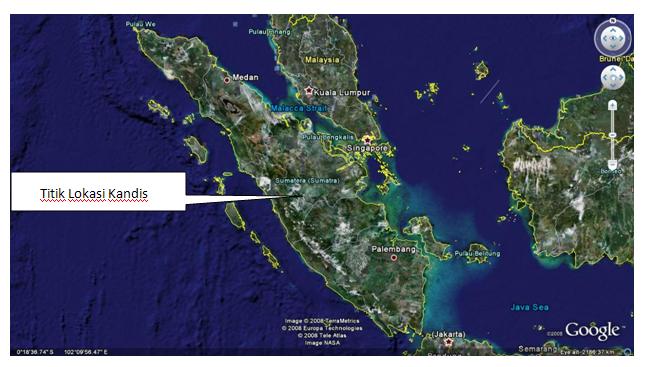
Topographical analysis conducted on a satellite map taken from Google Earth, found a location that is characterized in a tombo / story (a hill surrounded by a river). The area is at the point 0042 '58 LS and 101020 '14 East BT (Figure 1) or is almost at the midpoint of the island of Sumatra (the border of West Sumatra and Riau). The location is in the middle of the Lubuk Jambi customary forest, by the government used as a protected forest area called Bukit Betabuh protected forest. The distance from the central Sumatra highway is approximately 10 km to the west, with a hilly topography.
Figure 1 Hypothesis Location of Dhamna Palace
Location / expedition searches are carried out with simple terrestrial navigation equipment, using maps, compasses and binocular binoculars. At the destination location, found things that characterize the hill as a relic of human civilization. Approximately 2 km before Bukit Bakar found karst stone / coral sea lined up, this stone is thought to be the royal outer ring fence (Figure 2)
Figure 2 The karst stone which is thought to be the royal outer ring fence
On a hill surrounded by a very clear river, at its peak found karst stones that meet the top of the hill (Figure 3). The karst stone on the eastern and northern slopes is exposed, while the southern and western slopes are buried. The southeast slope was found like a stone pillar that was thought to be a former palace tower (Figure 4).
Figure 3 Karst stones that meet the hilltop
Figure 4 The alleged stone pillar of a former palace tower
On the eastern slope of the upper hill about 1200 m from the river found the mouth of the cave which is thought to be the palace door, but this door on the inside is already covered by rubble. This cave door is 5 meters high with a room in it as far as 3 meters, and inside the cave it looks like there is a large room inside but is closed (Figure 5).
Figure 5 Mouth of the cave which is thought to be the entrance of the palace
On the southern slope of the hill to the west, three terraces are found, allegedly a ring of water (Figure 6), while the north to east slopes are very steep and look like severe erosion. The terrace is an average width of 4 m, the distance between the river and the first terrace is approximately 200 m, the first terrace with the second terrace is approximately 400 m, the second terrace with the third terrace is approximately 500 m and the slope length is estimated at 1500 m. Based on the analysis on the map of this hill from east to west with a diameter of 3000 m, and from north to south with a diameter of 3000 m, the elevation difference between the river and the hilltop is 245 m. On the southwest slope, approximately at an altitude of 800 m slopes are found springs that flow profusely. This measure is based on estimates in the field and measurements on satellite maps. To get the actual size need measurements in the field.
Figure 6 Suspected terrace with a ring of water
Figure 7 Sketch The location of the Kandis kingdom site

Looking at the characteristics or character of the location, this location is very similar to the sketch of the kingdom of Atlantis written in the Greek mythology "Timeus and Critias" by Plato (360 BC). This mythology says "Poseidon carved the mountain where his lover lived into a palace and closed it with three round trenches whose width increased, varying from one to three stages and separated by rings of land of comparable magnitude". The Atlantis then built a bridge to the north of the mountains, making a route to the rest of the island. They dug a large canal into the sea, and next to the bridge, made a cave to the stone ring so the ship can pass and enter the city around the mountains; they made a pier from a wall of moat. Every entrance into the city is guarded by gates and towers, and walls surround each ring of the city. The wall was erected from red, white and black rocks that came from the trench, and was covered by brass, lead and orichalcum (bronze or brass). There is a similarity between this mythology and mythology in Lubuk Jambi.
Figure 8 Perspective of the Palace of Dhamna using Sketches of the Kingdom of Atlantis
Perspective
This is only an assumption that has not been proven scientifically, therefore it is necessary to do further research. Archeological surveys conducted at the site have not been able to conclude this location as a royal heritage because there is not enough evidence to conclude such. But it is certain that the area was once inhabited or visited by humans in the past.
Minangkabau mythology vs Lubuk Jambi mythology
Regardless of whether or not a mythology, the similarity of stories in the myth will lead to a bright spot. Tambo Minangkabau is so beautiful to be heard when a wedding party in the form of a traditional saying shows the glory of the past. Tambo Minangkabau and Tombo Lubuk Jambi, two contrasting stories. Minangkabau said that his ancestors were Sultan Maharaja Diraja, son of Iskandar Zulkarnain, who was anchored at the peak of Mount Merapi. Seawater is increasingly receding Maharaja Diraja's descendants there to spread to several regions in Sumatra. Another case with the Lubuk Jambi tambo, the tambo said that his ancestors were Maharaja Diraja, son of Iskandar Zulkarnain, anchored in Bukit Bakar and built civilization there. From Lubuk Jambi his descendants spread to Minangkabau and Jambi. But Tambo did not mention the year. That is why this area is called Lubuk Jambi which means the origin (lubuk) of the Jambi people. According to the story, Kandis since losing the war in the Sintong expedition and the concealment of their civilization, the story was told in secret from generation to generation by the Indigenous Architects or known in the term "The Ruler of the Pengulu". But the truth of this secret story needs to be proven.
From the two tambos above, a common thread can be drawn that is "both mentioned that their ancestors were Iskandar Zulkarnain". But in historical records, Iskandar Zulkarnain (Alexander the Great / Alexander the Great) did not have any children.
Plato-Atlantis-Iskandar Zulkarnain-Kandis
Plato, Greek-born philosopher (Greek philosopher) who lived 427-347 BC. Plato was a student of Socrates, a wise sage philosopher, who was later poisoned by the ruthless Athenian ruler in 399 BC. Plato often ventured, including his trip to Egypt. In 387 BC he founded the Academy in Athens, a school of science and philosophy, which later became a model for modern universities. The famous student of the Academy was Aristotle whose teachings had a great influence on philosophy to this day.
With the Academy, many of Plato's works were saved. Most of his writings took the form of letters and dialogues, the most famous being probably Republic. His writings cover subjects that range from science to happiness, from politics to natural sciences. Two of his dialogues "Timeus and Critias" contain the only original reference to the island of Atlantis.
How is his relationship with Iskandar Zulkarnain, Iskandar is the son of the King of Macedonia, Fillipus II. When he was 13 years old, King Philip employed the famous Greek philosopher, Aristotle, to be a personal teacher for Alexander. In three years, Aristotle taught various things and encouraged Iskandar to love science, medicine, and philosophy.
Iskandar Zulkarnain a student of Aristotle, and Aristotle a student of Plato. From this connection it can be assumed that the descendants of Iskandar Zulkarnain who arrived at Lubuk Jambi were inspired to build an ideal civilization / country such as Atlantis. So they built a dhamna palace "a replica of Atlantis". But all this still needs a deeper study.
CONCLUSION
From this preliminary research it can be concluded as follows:
- The hill, which is located at 0042 '58 LS and 101020 '14 East, is thought to be a Kandis heritage site intended in a custom story / tomb.
- Kandis Kingdom is thought to be the earliest civilization in the archipelago.
- The Kandis Kingdom is a replica of the lost kingdom of Atlantis.
This conclusion is still conjecture or hypothesis to conduct further research. Therefore archeological research will answer the truth of the allegations and the truth of the tombo / myth that exists in the midst of society.
THANK-YOU NOTE
The author thanks Kenogorian Pemangku Indigenous Lubuk Jambi Gajah Tunggal (Mahmud Sulaiman Dt. Tomo, Syamsinar Dt. Rajo Suaro, Danial Dt. Mangkuto Maharajo Dirajo, Sualis Dt Paduko Tuan, and Hardimansyah Dt. Gonto Sembilan), Drs. Sukarman, Mistazul Hanim, Nurdin Yakub Dt. Tambaro, Abdul Aziz Dt. Dano, Bastian Dt. Paduko Sinaro, Ramli Dt. Meloan, Marjalis Dt. Rajo Bandaro, and Syaiful Dt. Paduko The author also thanks Meutia Hestina, Apriwan Bandaro, and friends who helped me with the expedition: Mudarman, Bang Sosmedi, Yogie, Nepriadi, Zeswandi, Bang Izul, Diris, Ikos, and Yusran. Mas Sam and Erli thank you for the information.
BIBLIOGRAPHY
Datoek Toeah. 1976. Tambo Alam Minangkabau. Indonesian Reader. Bukit Tinggi.
Graves, E. E. 2007. The origin of the Modern Minangkabau Elite. Indonesian Torch Foundation. Jakarta.
Hall, D. G. E. without years. Southeast Asian History. National Business. Surabaya.
Kristy, R (Ed). 2007. Alexander the Great. Gramedia. Jakarta.
Kristy, R (Ed). 2006. Plato Thinkers on Ethics and Metaphysics. Gramedia. Jakarta.
Marsden, W. 2008. History of Sumatra. Bamboo Community. Depok.
Olthof, W.L. 2008. Babad Tanah Jawi. Narrative Publisher. Yogyakarta.
Samantho, A. Y. 2009. Mystery of the State of Atlantis began to unfold ?. Madina Jakarta Magazine. Issued in May 2009.
Suwardi MS. 2008. From Malay to Indonesia. Yogyakarta Student Library Publisher.
Coordinator of the Kandis Kingdom Heritage Search Team in Lubuk Jambi Negeri Gajah Tunggal, Kuantan Mudik District Kuantan Singingi Regency Riau Province
Collected from stories inherited from generation to generation by the Pemulu Adat Lubuk Jambi
Comment on the Kingdom above
Based on Robert Blust's research (1999), also the results of an Austronesian Basic Vocabulary Database (2008) investigation, from 10 branches of Austronesian languages, 9 branches of Austronesian languages were found on Formosa Island (Taiwan) while the remaining 1 branch, namely Malay-Polynesia spread from Madagascar to Island Easter and from Luzon Island to New Zealand. This implies that the Austronesian language family originated from Taiwan and then spread to the Pacific.
Your paper is something new to the laity and I show you the salute. However, there are a number of obstacles to your presentation of the connection between the Kingdom of Kandis and Atlantis which Plato tells in Cretias and Timeus.
Did you forget that Plato told that Atlantis existed 9000 years before Plato's time, or about 11,400 years ago? The latest search for Atlantis does indeed lead to the island of Sumatra, but your description of the Kingdom of Kandis as a replica of Atlantis is only a few matches, even though there are dozens of check lists that must be adjusted to focus on the approach.
The mythology that you describe has very little to do with the story of Atlantis, instead the focus is that the ruler of Atlantis is said to have 5 pairs of bloodlines, not to mention carvings and other physical features.
There are still too many clues to adjust to direct Atlantis to one of the regions on the island of Sumatra before making hypothetical conclusions. Nevertheless, this paper is quite interesting to become a discourse that people are interested in. Happy searching ...
Maybe the story of Atlantis was also heard by many Indonesians in ancient times, so they wanted to try to imitate and eventually make a replica like Atlantis.
One more thing that I was confused about, was read on the internet that there was a messenger from China who said that, the kingdom of Tulang Bawang had existed since the 3M century. But in the table in this story how can it be 771M?
In another story also said that the kingdom of Tulang Bawang was a kingdom that had triumphed during the Hindu era and had existed before the emergence of the greatness of the Srivijaya kingdom, even he said the Srivijaya kingdom was a form of federation of the Tulang Bawang kingdom and the Jambi Malay kingdom, from this story supporting the Tulang kingdom Onions have been around since the 3M century.
Hopefully someone is pleased to explain this or share information about the kingdom of Tulang Bawang. I really want to get a lot of historical information about the kingdom of Tulang Bawang, because I come from the Tulang Bawang area.
Salakanagara Kingdom (Salaka = Silver) or Rajatapura is a Hindu kingdom. The story or source is listed in the Wangsakerta Manuscript. This kingdom was built in 130 AD which is located on the coast of Teluk Lada (Pandeglang Regency, Banten). His first king was Dewawarman who had the title Prabu Darmalokapala Dewawarman Haji Rakja Gapara Sagara who ruled until 168 AD.
The above paragraph I quoted from the article; the question is; Did you call the king who ruled in 130 - 168 a haji? while Islam began to develop in the 1st year of Hijrah was 622 AD. Or do you have a typo about the year that should be called the year of Hijrah (130 H - 168 H). Try to trace your source again so that it does not become an arbitrary history in your paper?
- Good writing, sir, please share and copy paste permission, sir, to broaden my horizons with my friends. Thanks.
- Do not know what to say, it is extraordinary, what needs to be followed up is socialization to the public. especially Kuantan people singing themselves who don't know ... and need to be patented internationally
- Interesting article, especially with the warming of the analysis of Atlantis by Prof. Santos. Hopefully Prof.'s analysis Santos about Atlantis inspires us to be more enthusiastic, more proud and of course this is all for the advancement of our country Indonesia.
Indonesia super power ………………….
There is only input for this article about Alexander / Iskandar Zulkarnain. Some writings say that Iskandar Zulkarnaen in the Qur'an is different from Iskandar / Alexander Zulkarnaen in Greece.
Therefore it may be the saga of our elders from Minangkabau and Jambi that they are descendants of Iskandar Zulkarnaen is not wrong, because it may not be Iskandar Zulkarnaen of the Greek era, but others, which are in the Koran.
thanks.
The information is very good, so far the kingdom of kandis has never been revealed in the literature of school lessons, which I know is a district of Kandis in Riau Province, located between Rumbai and Duri (my hometown). We should be proud if it's true Atlantis is Sundaland, meaning our ancestors were great people. Too bad now we're down. but that is life, broken growing lost and change ...
I am the 4th generation of the last Sultan of Bulungan, Sultan M.M.Djalaluddin from the Kingdom of Bulungan, East Kalimantan. A little correction to the list of kingdoms above. Tidung Kingdom does not exist ... unless the legend of Tangkuban boat is recognized as history. What exists is the kingdom of Bulungan, it can be proven by the existence of a tomb and the site of the former palace (the palace was destroyed in the massacre by the TNI in 1965) The Kingdom of the Netherlands also noted the existence of the kingdom of Bulungan. Please make the list above corrected so that historical deviations do not occur.
There are some commentators who still object but it becomes a supporter to be more active in finding sources as an answer to the clue ... but bravely researching and opening up the discourse will necessarily invite all the world's archeologists to find out too ... ... how come for the people, the problem is really correct. no ... mash need to be checked ..... the problem is the history ... and your paper has been published in the book ... if this is wrong ... you have, changed wrong ... but great for you
Can you help me ...? To be sure, ... our territory of Indonesia is Heaven, meaning that from a long time ago our archipelago had been visited and occupied by, a stranger. namely Iskandar Muda. young iskandar could come to the archipelago because of the story of Arisroteles about the golden continent, .ato Andalas, .ato according to Pluto Atlantis. where Pluto has a student of Aristotle and Iskandar Zulkarnaen is a student who is directly appointed by the king to be an adviser to his son, namely the king Iskandar Zulkarnaen. of course the question is what when Iskandar Zulkarnaen came to the archipelago there were already residents there ..? if so, yes, that is a native descendant of Indonesia.
Please rectify the years of the establishment of the Lampung Tulang Bawang Kingdom, because according to the story of wanderers I-Tsing and Tom Pires, the Tulang Bawang kingdom had been established since the 3rd century, first standing before the Srivijaya Kingdom in Palembang.
The HAQ will return to the HAQ who are deceitful will perish (just open the Qur'an), in fact those experts of the book (especially the ancestors of Israel) really believe and understand about the history of this world but they deny (cover), then what about Islam ( please immediately learn the Koran, like Israel) will certainly understand more, if you are still confused / difficult, just study the history of Indonesia at least from 1945-1955 there is still a distorted history of history about Darus Islam (DI / TII) & PKI. Why is there DI / TII (or what is known today as NII) & PKI, is it only because of the struggle for power or is there an element of colonial invaders?
What is certain is that Indonesia will be led by those who use the Koran, namely the ISLAMIC COUNTRY OF INDONESIA (NII) in the form of the Republic, which has concrete evidence in the form of Modern Development (now it stands majestically, but is often covered by its activities by the government of the Republic of Indonesia). economics & education (do not invite things that smell anarchist, sporadic)
Pingback: Mysteries of the State of Atlantis begin to unfold? «Reinventing Atlantis Ancient Sunda Civilivation
Adonara Kingdom, Adonara Island, East Flores Regency, NTT Province. Where does the data come from is located in West Java?
sorry sir, I want to take part in correcting a bit, like the commentators above, there are indeed many errors in writing both the year and the location of the kingdoms on the list you made, such as onion bone, then you also mistakenly write the location of the country's taruma, because the country's taruma is not in the bid but in West Java, Taruma Negara is not in the Tangerang area at the moment, but between Karawang and Bekasi, maybe you can explore it by examining it first ... thank you ...
wow wow wow it seems more interesting to study the history of the archipelago, salute to writers & commentators who have contributed to the history of our ancestors. . .
Yes, although there are still many imperfections in the writing presented, but it must be a common challenge to uncover the history that has been obscured by certain people who do not want this nation to be large & advanced.
So, for the writer, I suggest to be more careful in presenting the data so that there are no errors in years and places (so that the gag is considered careless) because it can have fatal consequences in the disclosure of actual historical facts. And for the commentators, don't just talk about it, but also for writing with better quality than this.
The important thing is that the history search doesn't stop here, guys.
Success for All. . .
Sorry The above list is lacking, Period I Luwu Kingdom in Sulawesi was established BC long before there was a kingdom in the Archipelago, Period II Luwu Kingdom around the 7th century AD with King I Simpurussiang. Please read the article "Sureq I Lagaligo" Luwu's longest literary work and the oldest book of human literature in the world. by Prof. A. Kern (Dutch Anthropologist 1800s) aligns with the Ancient Greek book with the Mahabarata. In order to complete our cultural and historical treasures, and do not rule out the possibility that it was in Luwu the Center of Atlantis. Strangely, Luwu's history with its greatness is very well known in the world compared to historians in Indonesia. So there needs to be historical alignment, too much history in Indonesia is twisted. for your information.
wow, that's what makes me also curious ,. I have not read and do not have the Lagqigo Sureq I book. Can you help me to get the book or a copy? There is a high possibility that Atlantis was in Sulawesi, because some scholars who examined it, for example Oppenheimer, indicated that the civilization of EDen in The East was around the East coast of Sunda Land (Sulawesi & East Kalimantan, or in NTT-NTB?
Historical. "The lost kingdom of Timor"
"KING OF WEST TIMOR"
indeed ……… ..: The ancestors of the timor kingdom came from india belangkang (madagaskar) for millions of years ago, they came on the island of timah boat resting on a place called fatu kopan / ark noah which is now known as niki-niki and they lived in a place called tunbestua / niki-niki until the 8th century they moved to kupang there were two places, the first district office of kupang and the second mountain taibenu 'and they moved from tunbestua / niki-niki they raised the nubatonic to king in that place and guard that kingdom. and when he arrived in kupang then moved to oekabiti / oebaki amarasi and established the last timor kingdom in the jungle of the prohibition of amarasi until now the place is called Kopan Taimetan. and before they moved to amarasi in the 12th and 13th centuries they raised the taibenu to be king in that place so that they could guard the legacy of the eastern kingdom.
Emperor of East Timor and 2 kings of the first time in West Timor:
East Timor's name is KOPAN TAIMETAN ’he has 2 kings named Usif Natun (amanatun) to 2 Usif Nuban (amanuban). and Usif Natun is the king of the western part of the island of East Timor and the king of the eastern part of the island of East Timor, and the king of the Amanatun is the most notorious king and his knowledge is very high and his jewelry is made of gold, and if the king of this Amanuban is a king who likes to embrace (baeik) and 1 emperor and 2 kings are the real ones.
Dutch colonial period ...
East Timor was the first to oppose the Dutch kingdom of East Timorese emperor named Emperor Nepkeo. He was the 3rd warlord of the East Timor, therefore the Netherlands formed small kingdoms on the island of Timor in order to eliminate the East Timorese emperor so that the followers of East Timor in the slaughter of the Dutch were exhausted. in the current immigrant prison kupang (dive bridge) so that protect the East Timorese emperor from the Netherlands by twisting the facts of an amarasi envoy named ELISA NUBATONIS / TAINNESU 'so that the Dutch no longer look for the East Timorese emperor as KETURUNAN KEO'kau in the Dutch era. call keo in the slaughter! it turns out that there is still one person left who is named RUBEN KEO / RAISTANIS / NEPARASI. so in 1719 the emperor TIMOTIUS KEO / TANIS / TAINNEPA the 4th descendant of the East Timor gave his royal scepter to the 2nd king of KORO.
Go after the descent of KAISAR KOPAN TAIMETAN1. TAIMETAN COFFEE KAISAR 2. KEO KAISAR 3. NEPKEO / AMARATION KAISAR (hence amarasi be the name) 4. TIMOTIUS KEO KAISAR / TANIS / TAINNEPA 5. RUBBER KEO / RAISTANIS / NEPARATION 6. SIMON PETRUS KEO
The territory of the kingdom of Timor east to Madagascar.
Very good article. Continue with other good works. Long live the archipelago!
THE KINGDOM OF ATLANTIS'S MEMBERSHIP AROUND NTT, NTB, MALUKU, SULAWESI !!!
Oppenheimer, indicated that the civilization of EDen in The East was around the East coast of Sunda Land (Sulawesi & East Kalimantan, or in NTT-NTB? As corrected by Father Ahmad Samantho above, in fact the Garden of Eden is in the Maluku, Sulawesi, NTB regions , NTT as indicated by the Wallace-Weber Line, as the Central region dividing the fauna-flora to the Sunda plain (West) and to the Sahul plains (East) .This region is also the sea divider at certain seasons, the Vortex Center in the Banda Sea: that is, dividing the sea to the waters of the Pacific Ocean and Indian Ocean
It also serves as a gateway to sail to the East or sail to the West, or sail from the southern region of the world to the northern region of the world, ie from the south, the east of the gate is in the Savu Sea (between the islands of Timor, Sumba, .. along the Flores Island and the Solor Islands. : adonara, solor, lembata, alor) enter through the ombai strait (Alor), then the Banda Sea continues along the sea between the islands of Maluku) ... continues to the West of America through the Pacific Ocean, or also to the North Pole of the World. As well as various other atlantis features, ELEPHANT, making sailboats, Sandalwood fragrances, gold, spices, volcanic belts, myths about Garuda as a spacecraft, ringed sea characters, narrow straits in the Solor islands and dangerous waters, so that sailors / sailors who are not used to it may not penetrate the waters to an ocean or new world. The civilization system of the Atlantis of the Cross (Arysio Santos), which was elaborated from the idea of the famous philosopher Plato about a society that has been highly civilized, and became the biological mother of the World Civilization.
- Maridup: Hajj is from aji (sangsekerta), not from Hajj b. Arabic / Islam.
- Hakusamada Hidiralasifa Lawabima Sangkalasifa "Where is the metallic center there, the door of the ummasa now. Haka Hukumuma does not live in Siralasira".
Main Literacy
Source:
http://yasirmaster.blogspot.com/2011/06/k kingdom-kandis-atlantis-nusantara.html
Photo: Special




 Posts
Posts

